Why simple tools work better than 90-page planners
A calm guide to reducing overwhelm without adding more structure than you need.
Overwhelm isn’t solved by more pages.
It’s reduced by fewer decisions.
The Illusion of “More”
It’s easy to believe that a bigger planner will solve overwhelm.
More pages.
More trackers.
More systems.
More sections for every possible scenario.
It feels reassuring at first - like you’re finally organised.
But most overwhelmed days are not caused by a lack of pages.
They’re caused by:
Too many open loops
Competing priorities
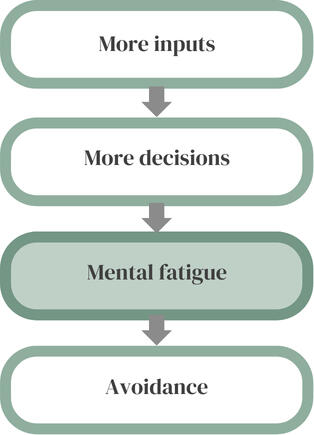
Decision fatigue
Limited capacity
Mental clutter
When cognitive load is high:
You struggle to prioritise
You avoid starting
You default to reacting
You feel behind before you’ve begun
Overwhelm is not a planning problem.
It’s a cognitive problem.
Overwhelm is not a planning problem.
It’s a cognitive problem.
Why More Planner Sections Increase Mental Load
Every section in a planner requires a micro-decision.
"What goes here?"
"How much detail?"
"Am I doing this properly?"
By the time you reach the actual task, your mental energy is already depleted.
Large planners often increase evaluation:
"Am I using this correctly?"
"Should I be tracking this too?"
"Am I falling behind on my own system?"
Simple tools reduce those decisions.
They narrow your focus instead of expanding it.
When decisions multiply, clarity shrinks.
Clarity Comes From Subtraction
Most people don’t need more ways to organise their tasks.They need:
Fewer priorities
Clearer boundaries
Permission to let things wait
A realistic view of their capacity
Simple tools work better because they:
Limit inputs
Reduce formatting decisions
Remove unnecessary categorisation
Focus on one thinking shift at a time
Clarity comes from subtraction.
The Problem With “Everything Planners”
Large planners often try to account for every possibility:
Habit tracking
Goal setting
Time blocking
Meal planning
Mood logging
Project tracking
Reflection prompts
Gratitude journaling
Productivity scoring
None of these are wrong.
But when you are already overwhelmed, breadth can feel like expectation.
And expectation increases pressure.
Pressure makes it harder to start.
Everyday Planners vs Simple Tools:
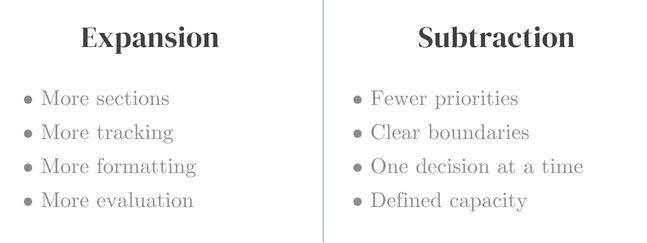
Clarity grows when complexity shrinks.
What Actually Helps on Hard Days
On overloaded days, what helps most is:
A place to unload your thoughts
A way to narrow priorities
A quick capacity check
One small, certain next step
Not ten sections.Not colour coding.Not optimisation.Just clarity.
When your thinking becomes clearer, action becomes lighter.
Simple Does Not Mean Basic
There’s a difference between minimal design and minimal thinking.Simple tools can still be structured.They can still be grounded in behavioural science.But they remove:
Decorative clutter
Performative productivity
Excess categorisation
Perfectionism traps
The goal of planning is not to build the perfect system.
It’s to build a system you’ll actually use.
A Different Approach
Instead of adding more structure, reduce to what matters first.
The Flow into Focus Method™ is simple:Reset → Clarify → Move
Not in a rush.Not perfectly.Just enough.
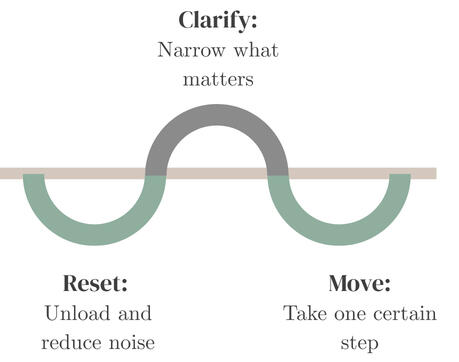
Clarity often lives in smaller spaces.
And simple tools make room for that.
A Calmer Way to Plan
If larger planners have left you feeling:
Overwhelmed
Guilty
Frustrated
Behind
You are not failing.
The system might simply be too heavy for your current capacity.
Instead of asking:
“How can I organise everything?”Try asking:
“What needs my attention right now?”
“What is realistic today?”
“What would make this feel lighter?”
If this way of thinking resonates, explore the Flow into Focus Studio reset tools designed to reduce overwhelm without adding more pressure.
They’re built around one idea:
Clarity first.
Structure second.
Action, gently.